Wasps Take Over Tree-Built “Homes” for Ants
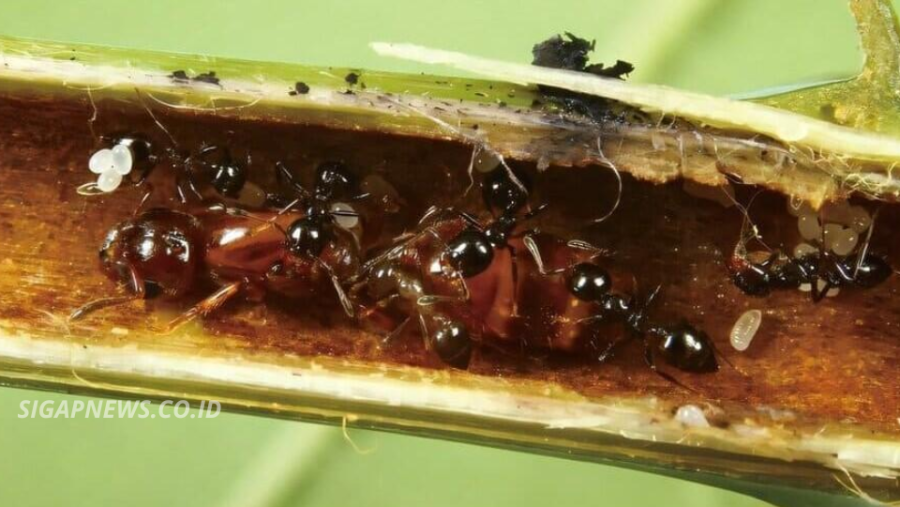
BORNEO, MALAYSIA – Scientists have uncovered a surprising shift in one of tropical Borneo’s long-standing ecological partnerships: predatory wasps are taking over hollow stems of Macaranga pearsonii trees that evolved to provide shelter for protective ant colonies.
The discovery was made by an international research team involving Queen Mary University of London, the Royal Botanic Gardens, Kew, the Biology Centre of the Czech Academy of Sciences and other institutions. The findings were published in PeerJ in 2026.
Macaranga pearsonii belongs to a group of tropical plants known for their close relationship with ants. The trees produce hollow chambers inside their stems where ants can establish colonies and also provide them with nutritious food.
In return, the ants defend the plants against herbivorous insects, including leaf-eating caterpillars. Researchers estimate that this mutualistic relationship between Macaranga plants and their protective ants has existed for at least 10 million years.
But when researchers examined young trees growing in logged forests and oil palm plantations, they discovered unexpected occupants inside some of the stems.
Predatory wasps were using the cavities as nurseries. Adult wasps capture and paralyze flies before placing them inside the plant cavities, providing food for their developing larvae. The structures originally associated with ant protection had effectively been repurposed for wasp reproduction.
The researchers found that wasp occupation was much more common among Macaranga trees growing in oil palm plantations than in heavily logged forests. Trees occupied by wasps also consistently had smaller ant colonies.
However, the scientists caution that the relationship does not yet prove that wasps are directly eliminating the ants. Smaller ant colonies may make trees more vulnerable to wasp occupation, or wasps may reduce ant colony size. Further experiments are needed to determine the direction of cause and effect.
Researchers also do not yet know whether the wasp is native or introduced. What they found, however, is a clear association between wasp occupation and human-disturbed landscapes.
The finding could have broader implications for tropical forest recovery. Macaranga species are often among the early plants to establish themselves in damaged or cleared areas. If reduced ant protection makes these trees less healthy, their ability to contribute to forest regeneration could potentially be affected.
The study highlights how ecological disruption can occur long before species disappear. In this case, the warning sign is a subtle change inside the hollow stems of tropical trees—where a partnership that has survived for millions of years may be undergoing a new transformation.
Editor :Farros
Source : Queen Mary University of London, Royal Botanic Gardens Kew, PeerJ, ScienceDaily, Phys.org.