Scientists Find New Clue to the Universe’s Expansion
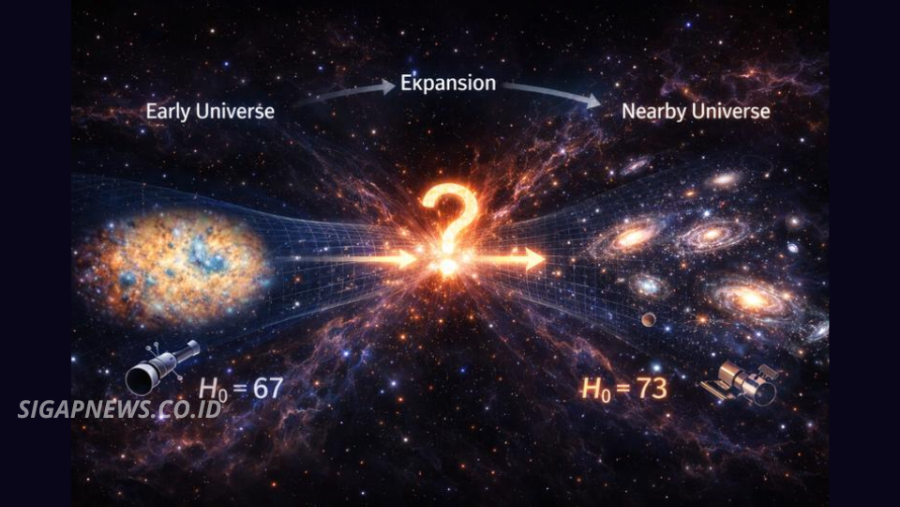
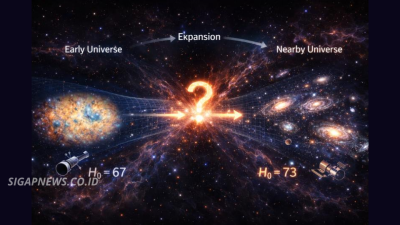
JAKARTA – Scientists have found a new clue that could help explain why measurements of the universe’s expansion rate do not agree. Tiny magnetic fields believed to have existed shortly after the Big Bang may have influenced the early universe and eased the long-standing “Hubble tension.”
The finding comes from researchers who used detailed three-dimensional simulations to examine how primordial magnetic fields could have affected the formation of hydrogen during the universe’s early stages.
Their study, published in Nature Astronomy, suggests that magnetic fields with present-day strengths of around 5–10 pico-Gauss could have altered the process known as recombination, when the early universe became transparent.
That process matters because it affects the cosmic microwave background (CMB), the faint radiation left over from the early universe. Scientists use patterns in the CMB to estimate how quickly the universe is expanding.
The problem is that this estimate does not fully match measurements based on the nearby universe, including observations of Type Ia supernovae. The disagreement is known as the Hubble tension.
Researchers found a mild to moderate statistical preference for primordial magnetic fields, depending on which datasets were combined. The significance ranged from about 1.8 sigma to 3 sigma, meaning the evidence is intriguing but not strong enough to be considered a confirmed discovery.
The proposed mechanism is relatively simple: magnetic fields could have caused matter in the early universe to become slightly more clumpy. This would have accelerated recombination and changed the cosmic “ruler” used to interpret the CMB.
Researchers say future high-resolution measurements of the CMB will be crucial to determine whether these ancient magnetic fields actually existed.
If confirmed, primordial magnetic fields could provide more than an explanation for the Hubble tension. They could also offer scientists a new window into the physical conditions of the universe shortly after the Big Bang.
Sumber: Nature Astronomy, The Conversation, ScienceDaily, SLAC National Accelerator Laboratory, Simon Fraser University.
Editor :Farros
Source : Nature Astronomy, SLAC National Accelerator Laboratory, Simon Fraser University, NASA Science, Unive