AI Searches 100 Million Options to Improve NASA Rocket Alloy Printing
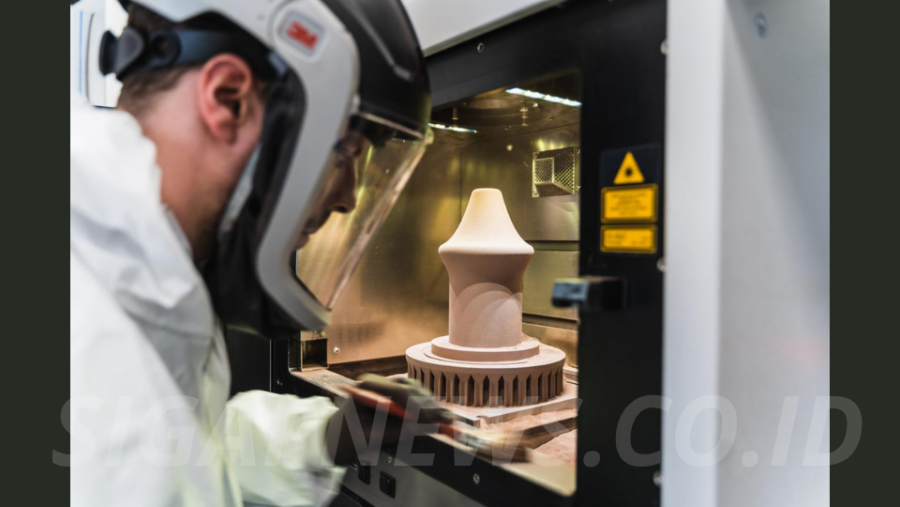
WASHINGTON – Researchers at Washington State University (WSU) have used artificial intelligence to search through more than 100 million possible 3D-printing configurations, identifying six successful settings after conducting only 40 physical experiments.
The research focuses on GRCop-42, a copper-chromium-niobium alloy developed by NASA for high-temperature aerospace applications. The material is used in demanding environments, including liquid rocket engine combustion components, because it combines high thermal conductivity with strength at extreme temperatures.
Printing the alloy has traditionally required high laser power, making it difficult for many commercially available 3D printers to process. Testing millions of possible combinations manually would also be prohibitively expensive and time-consuming.
“Ninety percent of commercial printers cannot print this metal alloy,” said Jana Doppa, a Washington State University professor who led the research.
The researchers developed an AI-driven adaptive experimental design that learned from previous failed experiments and selected new configurations for physical testing. The system initially used data from 37 unsuccessful printing configurations before recommending additional candidates.
Over approximately three months, the researchers identified six successful configurations at different laser power levels. One of the most significant results was the successful printing of GRCop-42 at just 500 watts of laser power, demonstrating that the alloy could be processed at substantially lower power than previously considered practical.
The findings were published in the Proceedings of the AAAI Conference on Artificial Intelligence. The researchers said their AI-guided approach could potentially be adapted to other scientific problems where the number of possible experiments is enormous and physical testing is costly.
The breakthrough could also broaden access to GRCop-42. According to the research, the newly identified configurations allow the alloy to be printed on more than 90 percent of printers operating between 500 and 1,000 watts, potentially reducing the need for specialized high-power systems.
NASA previously developed GRCop-42 for rocket propulsion components. NASA technical documentation describes the alloy as having high thermal conductivity, strong elevated-temperature performance and suitability for combustion chamber applications.
The WSU team believes the broader significance lies in the way AI can guide real-world scientific experimentation. Instead of simply analyzing existing data, the technology can help researchers decide which physical experiments should be performed next, potentially saving materials, energy, time and money.
The same strategy could eventually be applied beyond aerospace manufacturing, including other materials research and scientific fields where successful outcomes are rare and the number of possible experiments is extremely large.
Editor :Farros
Source : Washington State University, AAAI Proceedings, NASA Technical Reports Server, ScienceDaily, Phys.org