Ancient Egyptian Military Route Revealed After Thousands of Years
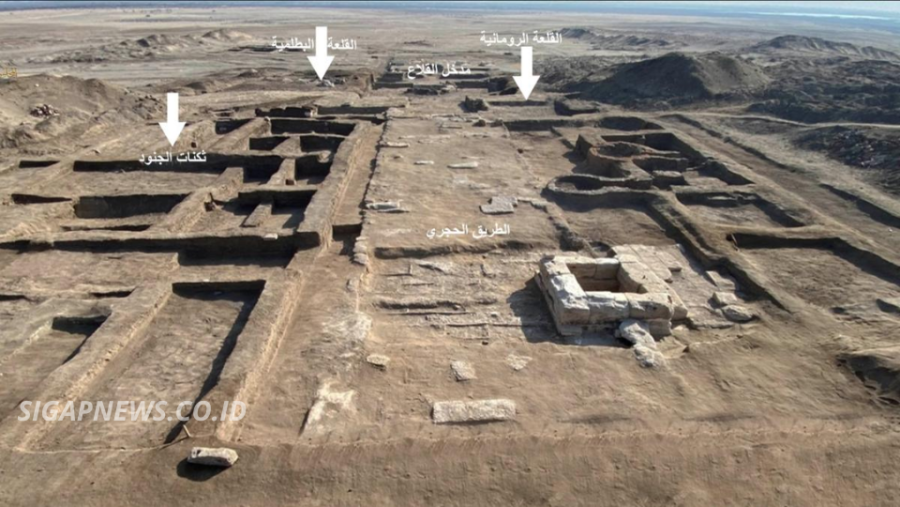
EGYPT – Archaeologists have uncovered new evidence revealing the strategic importance of one of ancient Egypt’s major military corridors after excavations at Tell Abu Seifi in Qantara East, Ismailia Governorate uncovered an inscribed stone lintel, ancient roads, defensive walls and remains of a temple complex.
The discoveries are shedding new light on the Horus Military Road, an ancient military and trade corridor that connected Egypt’s eastern frontier with Sinai and the Levant.
Among the most significant finds is a large sandstone lintel, broken into two pieces and inscribed on three sides with the royal titles of Ramesses II. The inscription also refers to restoration work on a statue of Horus, described as “Lord of Mesen.”
The inscription is particularly important because archaeologists are investigating whether Tell Abu Seifi could be the location of Mesen, a long-lost Egyptian city known from ancient texts.
Mesen is believed to have been associated with the Horus Military Road, a strategic corridor running from Egypt’s eastern Nile Delta through Sinai toward the Levant. The route served military, administrative and economic purposes and helped protect Egypt’s eastern frontier.
Excavations at Tell Abu Seifi also revealed a massive mudbrick enclosure wall with gateways, internal rooms and several layers of construction. Archaeologists have revised their earlier interpretation of the structure, concluding that it was the outer enclosure surrounding a temple complex rather than the temple itself.
Two successive stone roads were also discovered leading toward the temple. The earlier road dates to the Ptolemaic period, while a narrower Roman road was later constructed over it.
Other discoveries include part of a statue from Egypt’s 26th Dynasty, a headless and footless statue from the Late Period, the torso of a royal basalt statue and fragments of falcon statues made from basalt and limestone.
The site also reveals how its role changed over time. The temple reached an important stage of development during the Ptolemaic period before parts of the complex were converted into Roman military barracks in the third century AD. During the Late Roman period, the area was later used as a limestone quarry.
The evidence suggests that Tell Abu Seifi was more than a religious center. Across centuries, the site served successive military, religious, administrative and economic functions, reflecting its strategic position on Egypt’s eastern frontier.
Archaeologists, however, have not yet conclusively identified Tell Abu Seifi as the ancient city of Mesen. Further excavations and scientific research will be needed.
If confirmed, the discovery could provide a clearer picture of how ancient Egypt defended and administered its eastern frontier and moved armies toward Asia more than 3,000 years ago.
Editor :Farros
Source : Egyptian State Information Service, Ministry of Tourism and Antiquities Egypt, The National, Arab Ne