Interstellar Comet 3I/ATLAS Returns, Offering Rare Glimpse Beyond Our Solar System
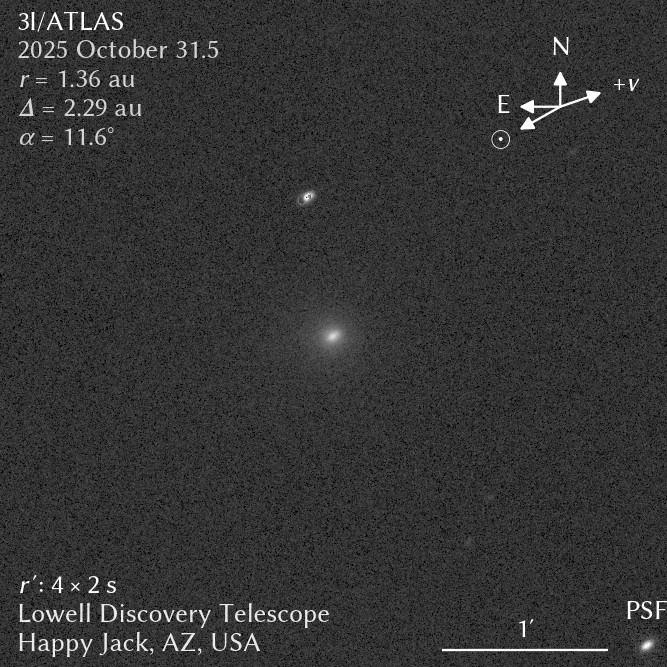
Comet 3I/ATLAS is the bright white spot in the center of the image, while the spot above it is a star that appears distorted due to the comet's motion.
CHILE — Astronomers have captured the first images of interstellar comet 3I/ATLAS after it reemerged from behind the Sun marking only the third interstellar object ever detected passing through our solar system, following ?Oumuamua (2017) and 2I/Borisov (2019), according to NASA.
Discovered on July 1, 2025, by the Asteroid Terrestrial-impact Last Alert System (ATLAS) survey in Chile, 3I/ATLAS follows a hyperbolic trajectory, confirming its origin beyond the Sun’s gravitational field, NASA stated on its official website.
As it approaches the Sun, the comet has begun to emit a bright blue glow a phenomenon caused by gas emissions from its icy core, Live Science reported. The object has also brightened enough to be visible through amateur telescopes in the Northern Hemisphere, as it nears perihelion, or its closest point to the Sun, expected in late October 2025.
“Our statistical method suggests that 3I/ATLAS is very likely to be the oldest comet we have ever seen,” said Matthew Hopkins, an astronomer at Oxford University, quoted by Live Science.
Recent data from the Vera C. Rubin Observatory estimate the comet’s nucleus to measure about 11 kilometers (7 miles) across, making it the largest interstellar object ever observed.
Because it originated outside our solar system, 3I/ATLAS provides scientists with a rare opportunity to analyze material from other planetary systems, potentially unveiling how other worlds form and evolve, National Geographic noted.
Traveling at over 210,000 kilometers per hour (130,000 mph), the comet’s icy surface is sublimating under solar radiation, forming a coma and a tail classic features of an active comet. The blue-green hue observed is likely caused by diatomic carbon and cyanogen gases interacting with sunlight, Live Science explained.
NASA scientists plan to use the James Webb Space Telescope (JWST) and various ground-based observatories to monitor 3I/ATLAS’s composition and chemical changes as it orbits the Sun.
“Each interstellar visitor offers a direct look into the chemistry of other planetary systems,” NASA said in a planetary science briefing.
Researchers predict that discoveries of similar interstellar visitors will increase in the coming decades as sky survey technology advances.
“We expect to discover many more interstellar objects in the coming decades,” said Aster Taylor of the University of Michigan, as quoted by The Debrief.
Despite its impressive size and brightness, 3I/ATLAS poses no threat to Earth, with its closest approach expected to be around 270 million kilometers (170 million miles) in December 2025, Live Science confirmed.
Editor :Farros
Source : NASA, Live Science, National Geographic, The Debrief