Scientists Develop New Way to Produce Hydrogen from Water
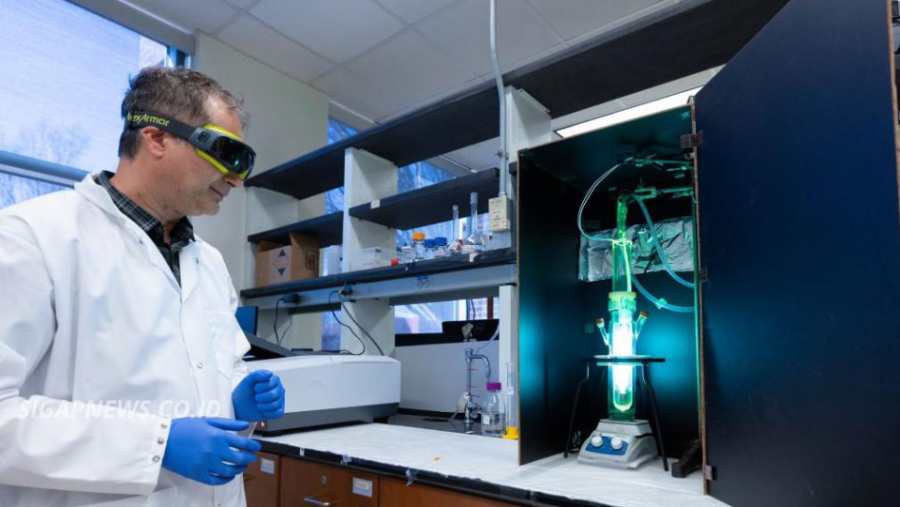
OREGON, USA – Researchers at Oregon State University (OSU) have developed a new material that uses light to produce hydrogen from water without requiring an additional expensive metal cocatalyst.
The discovery could open a new pathway toward simpler and potentially cheaper solar-driven hydrogen production. The research was published in the Journal of the American Chemical Society in September 2026.
Led by OSU scientist Kyriakos Stylianou, the team worked with a material known as BVR-19, part of a family of porous materials called metal-organic frameworks (MOFs).
BVR-19 has an unusual sulfur-sulfur bond within its organic structure. When exposed to light, the bond temporarily breaks and produces reactive sulfur species that help separate and move electrons needed to drive hydrogen evolution.
“The organic component does the important work,” Stylianou said. Instead of relying mainly on metal atoms, the material uses sulfur-containing organic components to capture light energy and direct electrons toward the sites where hydrogen can be produced.
One of the most notable aspects of the research is that BVR-19 does not require an additional expensive metal catalyst. Reducing dependence on costly metal cocatalysts could simplify the design of future light-driven hydrogen systems and potentially improve their economic prospects.
The researchers also found that BVR-19 can form spontaneously in an aqueous solution at room temperature. That characteristic could reduce the energy required to manufacture the material.
Hydrogen is widely used in fuel cells and industrial processes, including ammonia production, metal refining and plastics manufacturing. Today, much of the world's hydrogen is produced through methane-steam reforming, a process based on natural gas that generates carbon dioxide.
Oregon State University estimates that conventional hydrogen production currently costs about US$1.50 per kilogram, compared with roughly US$5 per kilogram for green hydrogen. The researchers hope their findings can provide new design principles for developing more competitive green-hydrogen technologies.
However, the discovery remains at the research stage. Further work is needed to evaluate the material's efficiency, long-term stability, scalability and economic feasibility before the technology could be considered for large-scale commercial applications.
Editor :Farros
Source : Oregon State University, Journal of the American Chemical Society (JACS), ScienceDaily, EurekAlert!