Amateur Astronomer Looking for Campsite Finds Ancient Asteroid Crater
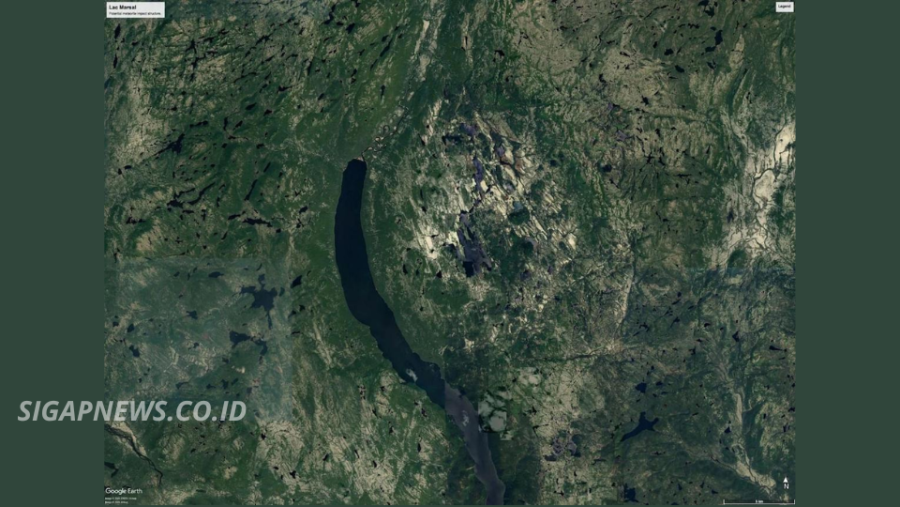
A satellite image showing the circular shape of Uhackatik with Lake Marsal at its center. This image is particularly striking because it clearly shows what the crater’s structure looks like from above. NASA states that the image was captured by Lands
QUEBEC – A simple search for a camping spot in Quebec, Canada, unexpectedly led amateur astronomer Joël Lapointe to a major geological discovery: a 390-million-year-old impact crater. Lapointe spotted the unusual circular formation near Lake Marsal on satellite maps in 2024, and subsequent field research confirmed that the structure was created by an ancient cosmic impact. NASA Earth Observatory highlighted the discovery on September 15, 2026.
Lapointe was using online satellite maps while planning a trip to Quebec’s remote Côte-Nord region when the circular landscape caught his attention. He suspected the depression could be an impact crater and contacted experts in Europe and North America.
The discovery eventually prompted a scientific expedition in October 2025. A team led by Gordon Osinski, a planetary geologist at Western University, traveled to the remote site by floatplane before crossing difficult terrain to reach the suspected crater.
Scientists were initially cautious. Earlier geological mapping had suggested that the breccia rocks in the area were linked to a volcanic structure known as a diatreme. But on the second day of fieldwork, researchers identified shatter cones, distinctive rock formations produced by the intense shock waves of an impact.
“It’s the only unequivocal evidence of an impact event that you can see in the field with the naked eye,” Osinski said, according to NASA.
The structure, now named Uhackatik, spans approximately 25 kilometers. Rock samples indicate that the impact occurred around 390 million years ago, long before humans existed on Earth.
The scale of the discovery makes it particularly significant. NASA describes Uhackatik as the largest impact crater discovered since the 31-kilometer Hiawatha structure was identified in 2018. If an object of similar size struck Quebec today, researchers estimate that it could devastate major cities across the region and have global climate consequences.
The name Uhackatik was chosen after consultation with the Innu Council of Ekuanitshit. Researchers consider the evidence for an impact origin essentially conclusive, although formal recognition by a Meteoritical Society committee is still expected.
The discovery highlights how satellite mapping and observations by citizen scientists can still reveal major geological secrets hidden on Earth for hundreds of millions of years.
For Lapointe, the discovery began with something remarkably ordinary: planning a camping trip. “I encourage everyone to not ignore intuition or an observation, even if it isn’t part of your field of expertise,” he said.
Editor :Farros
Source : NASA Earth Observatory, Western University, The Planetary Society, ABC News, CBC, Space.com, Smithso