Indonesia’s 67,800-Year-Old Cave Art Rewrites Human History
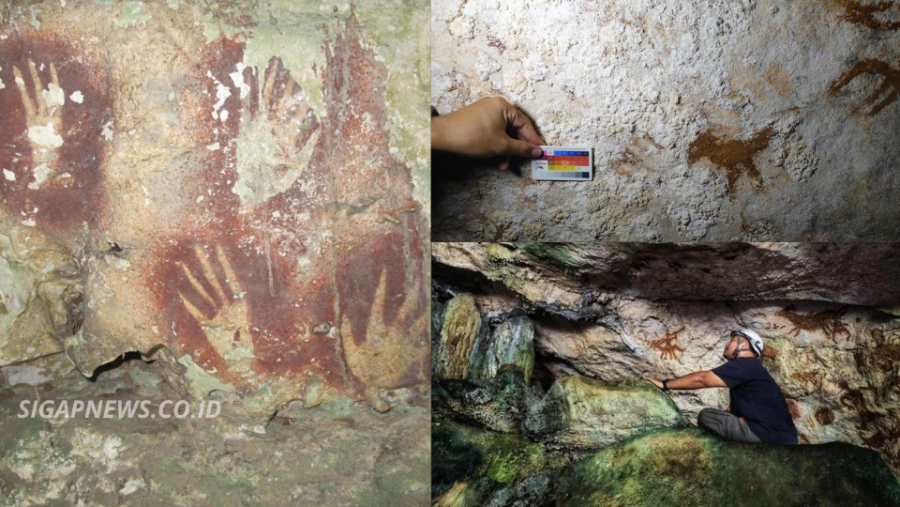
A 67,800-year-old hand stencil discovered at Liang Metanduno Cave on Muna Island, Southeast Sulawesi, offers new clues about early human creativity and migration.
MUNA, SOUTHEAST SULAWESI — A faint hand stencil on the wall of Liang Metanduno Cave on Indonesia’s Muna Island dates to at least 67,800 years ago, making it one of the oldest examples of human rock art ever identified. The discovery is providing new clues about early creativity, symbolic behavior and the movement of humans through Southeast Asia.
The research, published in Nature in January 2026, found that the stencil was created by placing a hand against the cave wall and blowing pigment around it, leaving a negative outline of the hand.
Scientists established its minimum age by using laser-ablation uranium-series dating on mineral deposits that formed over the artwork. The dated mineral layer indicates that the underlying hand stencil is at least 67,800 years old.
The significance of the discovery goes beyond its age. The Muna stencil shows that humans living in what is now Indonesia were engaging in symbolic artistic activity tens of thousands of years ago.
Researchers surveyed caves across Southeast Sulawesi and documented 44 rock-art sites, including 14 previously unknown locations. The findings suggest that the region contains a much broader prehistoric artistic record than previously recognized.
Clues to the Journey Toward Australia
The discovery also matters for understanding early human migration.
Sulawesi lies within Wallacea, the island region that formed a crucial geographic zone between mainland Asia and Sahul, the ancient landmass connecting Australia and New Guinea.
Researchers say the presence of very early rock art in Sulawesi strengthens the case that early humans travelled through a northern route toward Sahul. The evidence adds to the growing picture of the cultural world of populations that contributed to the ancestry of Indigenous Australians and Papuans.
Indonesia had already attracted global attention for prehistoric art in the Maros-Pangkep karst region of South Sulawesi. A narrative cave painting there has been dated to around 51,200 years ago, making it one of the oldest known examples of figurative storytelling through art.
The Muna discovery pushes that story even further back.
A Fragile Window Into the Past
But the discovery also highlights the challenge of protecting prehistoric heritage.
Earlier research in the Liang Kabori area of Muna found that among 43 rock-art sites examined, 84 percent were classified as damaged and another 14 percent as severely damaged. Researchers identified both natural and human-related threats to the artwork.
That makes conservation crucial. The paintings are not simply ancient images preserved on cave walls. They are physical evidence of how humans lived, travelled and expressed ideas tens of thousands of years ago.
For international visitors, Muna offers a different way to understand Indonesia. Its history does not begin with kingdoms, temples or colonial records.
It reaches back to a time before written history—when a human hand was placed against a cave wall and pigment was blown around it.
That small outline has survived for more than 67,000 years.
Editor :Farros
Source : Nature, Reuters, Associated Press, National Geographic, The Guardian, Kementerian Kebudayaan RI, BRI